Posted on
Aug 31, 2026
One Platform Done Well Beats Five Platforms Done Poorly
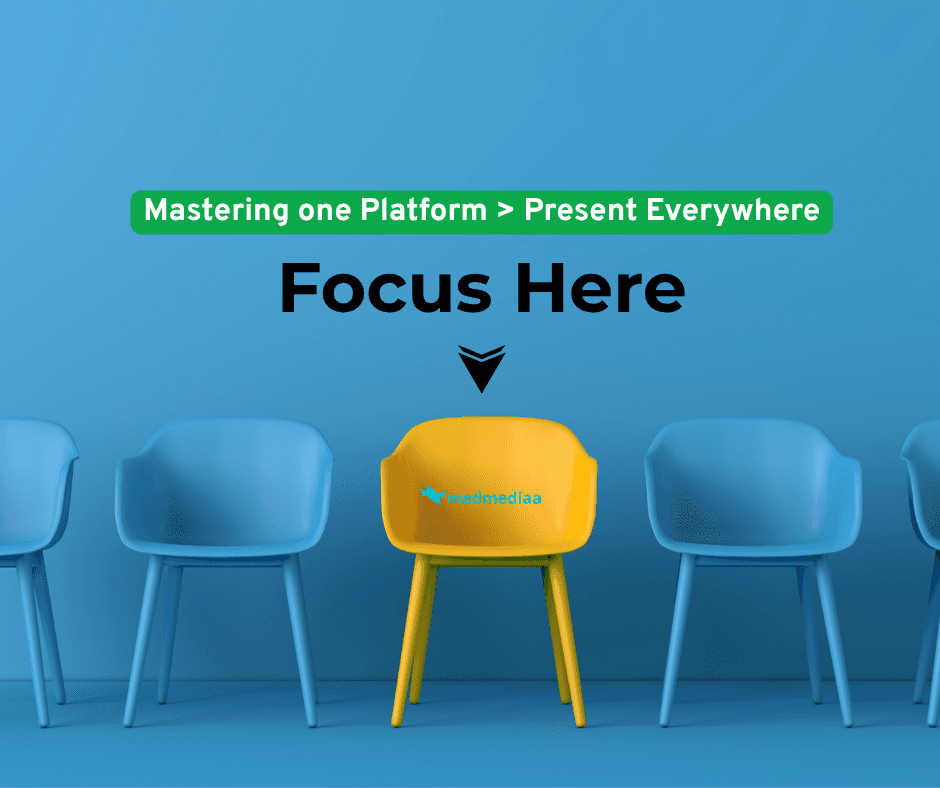
One Platform Done Well Beats Five Platforms Done Poorly - Here Is How to Choose Yours
The advice problem every doctor faces
Someone told you that you need to be on Practo. A colleague swears by Google. Your nephew says Instagram is where patients are finding doctors now. An agency called last week pitching a YouTube channel package. Another freelancer wants to rebuild your website. A third is offering to manage your Facebook page - which you didn't realise you had until he brought it up.
So you are doing a little of everything. Posting occasionally on Instagram when you remember. Your Practo profile exists but isn't fully filled out. You have been meaning to update your Google listing for three months. The website is somewhere on the internet, doing something unspecified. None of it is working particularly well, and you are not sure which platform to blame or which one to fix first.
Here is the honest answer: the platform is not the problem. The problem is that you are partially present on all of them instead of fully present on one. And partial presence, on any platform, produces almost nothing - while creating the impression, to every patient who finds you, that this clinic is not quite on top of things.
A doctor who shows up completely on one platform will consistently outperform a doctor who shows up halfway on five. This is not a theory. It is the predictable result of how digital trust is built - and how quickly it collapses when a patient finds a page that hasn't been updated since February.
Why being everywhere doesn't work - and why it feels like it should
The instinct to be present on every platform is understandable. More presence feels like more opportunity. If patients are on Instagram and Google and Practo and YouTube, surely being on all of them increases the chances of being found.
What this reasoning misses is the difference between existing on a platform and being present on it. They are not the same thing - and patients can tell the difference immediately.
Every platform has its own logic, its own requirements, and its own signals of credibility. Google rewards consistency - regular reviews, updated information, accurate hours, recent photographs. Practo rewards completeness - a fully built profile, prompt responses to patient queries, active appointment availability, collected reviews within the system. Instagram rewards frequency and human connection - regular content, a recognisable voice, direct engagement, the feeling of a living, active presence. YouTube rewards depth and patience - consistent uploads over many months, well-chosen topics, a doctor who is comfortable on camera and willing to invest time before results show.
To do any one of these properly requires real, recurring attention and effort. To do all of them simultaneously, while running a clinic and seeing patients, is not a digital strategy. It is a reliable way to ensure that none of them works well enough to matter.
The clinics and doctors who grow their digital presence are not the ones who are everywhere. They are the ones who chose somewhere - deliberately, based on specific knowledge of their patients and their own capacity - and showed up there completely and consistently.
The platform decision framework: three questions that point to the right answer
Choosing the right platform is not about picking the most popular one or following the advice of whoever spoke to you most recently. It is about understanding a specific intersection: where your particular patient, in your particular city, makes their particular decision about which doctor to see.
Three questions reliably point to that intersection.
Question one: Who is your patient and how do they search?
Patient behaviour varies enormously based on age, location, condition, and independence. An elderly patient in a tier-2 city whose family is making the doctor decision on their behalf behaves completely differently from a 28-year-old professional in a metro city who researches independently before booking anything.
The elderly patient's family asks neighbours, checks Google briefly for confirmation, and calls. For this patient profile, Google presence is the dominant factor - reviews, recent photographs, a working phone number, a correct address, and enough review volume to feel trustworthy. Practo may matter if the family is comfortable with online booking. Instagram and YouTube are largely irrelevant.
The independent young professional researches carefully. They compare options, read through reviews, watch video content, and want to feel they have a sense of the doctor as a person before they commit to visiting. For this patient profile, Instagram and YouTube do significant work - because they want the emotional preparation that a Maps listing cannot provide.
If your patients arrive primarily through referrals from other doctors, Google and Practo matter most - because the referring doctor sends them somewhere specific, and your digital presence simply needs to confirm the referral was a good one. If patients are finding you independently through search, awareness-stage platforms like Instagram matter more - because you need to earn their attention before they have any intention to book.
Question two: What stage of the decision are patients in when they find you?
This question is one that most doctors have never thought about - and it changes the platform choice significantly.
Some platforms capture patients at the point of crisis. They need a doctor now, their problem has become urgent, they search Google and call the first result that feels trustworthy. Google and Practo are crisis-stage platforms. The patient already has intent. They have already decided they need help. Your job is simply to not lose them - to have a presence that is reassuring enough for them to call rather than scroll to the next result.
Other platforms capture patients at the awareness stage - before they are sure they need help, while they are still learning, still building familiarity with a doctor's name and approach. Instagram and YouTube are awareness-stage platforms. The patient is not ready to book today. They may not book for weeks or months. Your job is to be the doctor they think of, and trust, when they finally are ready.
Both stages matter. But they require completely different content, completely different interactions, and completely different definitions of success. A doctor who treats Instagram like a crisis-capture platform - posting clinic information and waiting for immediate bookings - will be consistently disappointed. A doctor who understands that Instagram builds slow, long-term trust will invest in it appropriately and measure it accordingly.
Question three: What can you actually sustain?
This is the most important question. It is also the most consistently ignored one.
A YouTube channel with two videos and eight months of silence is not a digital asset. It is evidence, visible to every patient who finds it, that this clinic started something and abandoned it. An Instagram page that went quiet four months ago signals the same thing. An unanswered Practo query from six weeks back tells a patient that enquiries are not a priority here.
Digital presence is judged not just by what exists - but by how recent it is. A clinic with twelve Google reviews and the most recent one from yesterday feels more alive than a clinic with forty reviews and the most recent one from eleven months ago. Recency is a trust signal. Abandonment is its opposite.
An honest assessment of your time, your team, and your temperament - what you can realistically maintain week after week, month after month - should drive the platform decision more than any trend, any vendor pitch, or any advice from someone who does not know your specific situation.
A practical starting point for most independent clinic doctors in India
Every clinic and city is different. But across the range of independent medical practices in India, one sequence holds up consistently.
Start with Google. Without exception.
Google is where every patient goes, regardless of how they first heard your name. A referral gets Googled. An Instagram post leads to a Google search. A Practo listing gets cross-checked on Google. It is the foundation beneath every other platform - and if the foundation is incomplete, inconsistent, or neglected, no other platform fully compensates for it.
A complete, active Google presence means: correct and current contact information, accurate hours, recent photographs that show the clinic as it actually looks today, a consistent flow of genuine reviews, and responses to those reviews that show the clinic is engaged. This is the non-negotiable starting point. Build everything else on top of it.
Add Practo if your patient profile fits it.
Practo performs well for specialists in metro cities whose patients are actively searching by specialty and comfortable booking online. It performs less well for general practitioners in localities where most patients come through word of mouth and community referral. Knowing which situation describes your practice determines whether the investment in building and maintaining a Practo profile will return anything meaningful.
Choose one content platform - and only one - based on your patient profile and your honest self-assessment.
If your patients skew younger, urban, and research-driven, and if you are comfortable being on camera, YouTube will build deeper trust over time than almost any other platform. The videos are searchable, they last indefinitely, and they give patients a genuine sense of who you are before they meet you.
If your patients are active on Instagram, if short-form content feels more manageable, or if you express yourself more naturally in writing than on video - Instagram is your platform. Done consistently, with content aimed at the right audience, it builds a patient-facing presence that compounds over time.
Choose one. Build it to a standard that actually reflects who you are and what your clinic offers. Let it work - meaning give it enough time and consistency to show results - before adding anything else.
The psychology of the spread-thin doctor
There is something worth naming about why so many doctors end up partially present everywhere rather than fully present somewhere.
It is not laziness. It is anxiety - the quiet fear that if you are not on a platform, you are invisible there, and invisibility costs patients. The response to that anxiety is to claim a presence on every platform, which creates the appearance of coverage without the substance of it.
The irony is that thin presence on many platforms creates a worse impression than focused presence on one. A patient who finds your Instagram page last updated six months ago, your Practo profile half-empty, your Google listing with no response to any review, and your website with a broken contact form does not conclude that you are trying hard across many channels. They conclude that this clinic does not pay attention to detail.
That conclusion - drawn from digital scattered-ness - transfers directly to how they imagine you approach clinical care. Unfairly, perhaps. But reliably.
Build your presence where it actually matters
Choosing the right platform and building it properly requires knowing your patient profile, understanding the decision stage you are capturing, and being honest about what you can sustain. These assessments are specific to your specialty, your city, and your practice - and getting them right is the difference between a digital presence that works and one that occupies time without producing anything.
We have built a practical platform selection guide specifically for independent clinic doctors in India - one that takes the specific variables of your practice and points clearly to where your effort belongs.
Download the Platform Focus Guide - a structured decision framework for choosing the right digital platform for your specific clinic, with a patient profile mapping tool, a platform audit checklist, and a 60-day build plan for whichever platform is right for you.
Inside: a self-assessment tool for identifying your patient's decision stage, a Google presence audit checklist, a comparison of Practo versus Instagram versus YouTube for five common clinic types, and a content calendar template for your chosen platform.
The permission most doctors need
You do not need to be everywhere. You never did.
You need to be somewhere - fully, consistently, and in a way that a patient who finds you feels immediately that they have found something real and trustworthy. One platform built properly will bring more patients than five platforms built carelessly. One presence that feels alive and attentive will do more for your practice than a collection of abandoned pages that signal the opposite.
The doctors who understood this stopped feeling guilty about the channels they weren't maintaining and started showing up - reliably, repeatedly, with genuine presence - on the one that mattered most for their specific practice.
That reliability is what a digital presence is actually for. Not coverage. Not quantity. Presence that a patient can feel.
———————————————————————————————————————-
medmediaa helps doctors identify where their patients actually are - and build a presence there that works consistently, without spreading thin across everything.