Posted on
May 20, 2026
India's Mental Health Vacuum - And Why the Psychiatrist Who Posts Is Filling It
A young woman in Pune has been waking up at 3am every night for four months. She cannot explain why. She is not going through anything obviously terrible. She just cannot sleep, cannot concentrate, and feels a low-level dread that she has no name for.
She has not told her family. She will not visit a doctor - not yet, possibly not ever. But she has spent hours watching Instagram reels about "nervous system regulation," "trauma responses," and "high-functioning anxiety." She follows three wellness coaches, none of whom are clinicians. She has bought a supplement one of them recommended. She feels understood, but she is not getting better.
This is not an edge case. It is the dominant mental health journey in India right now.
Problem framing
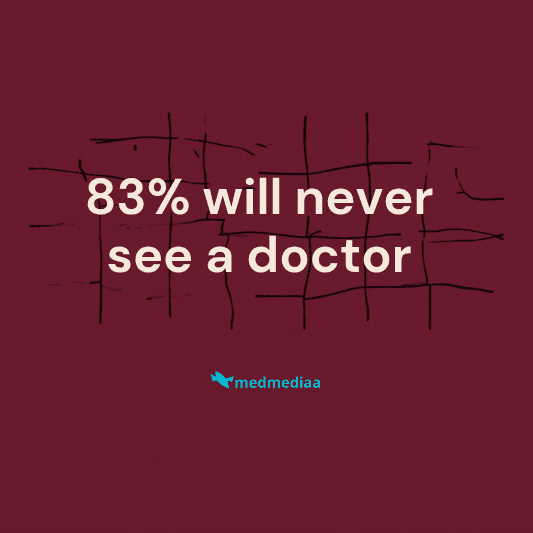
India is home to one of the largest and least-treated mental health burdens in the world. Over 200 million Indians - approximately 1 in 7 people - live with a diagnosable mental health condition. Of those, more than 83% will never receive any formal treatment. (WHO, via Mentis, 2025)
The reasons are well documented: stigma, cost, geography, and an acute shortage of professionals. India has 0.75 psychiatrists per one lakh people - less than a quarter of the WHO's recommended minimum of three per lakh. There are an estimated 9,000 to 11,000 practising psychiatrists in the country. The requirement, to meet basic care needs, is closer to 36,000. (The Week India, January 2026)
In many states, the number is far worse. Madhya Pradesh, for instance, has 0.05 psychiatrists per lakh population. For a person in a small city or rural district with a serious mental health condition, the system essentially does not exist.
Into this vacuum, social media has moved.
Since the pandemic, Indians have turned increasingly to online content for mental health guidance. The July 2025 Ipsos Market Essentials report found that 81% of Indian Millennials, 76% of Gen X, and 74% of Gen Z now look to social media influencers for health and wellness guidance. Mental health content is one of the fastest-growing categories. And the overwhelming majority of the people producing it have no clinical training.
A recent investigation cited by The Week India found that over half of popular mental health content on social media platforms contained inaccuracies or outright falsehoods — frequently promoting quick fixes, unverified products, and reductive explanations of complex conditions. The government has introduced guidelines requiring influencers to disclose qualifications. Enforcement, by its own admission, lags significantly.
The result is a country where millions of people are forming their understanding of mental health, treatment, and their own conditions through content created by people who are not qualified to provide it. Diagnosis is being replaced by self-identification. Professional care is being substituted with breath-work, journaling prompts, and supplement stacks.
Framework: The Vacuum-Fill Model
This is how India's mental health information crisis actually works. Call it the Vacuum-Fill Model:
STAGE 1 - THE NEED
Person experiences symptoms.
Stigma, cost, or geography prevents professional consultation.
STAGE 2 - THE SEARCH
Person goes online looking for understanding, validation, or answers.
STAGE 3 - THE FILL
Content is available. Mostly unqualified. Highly engaging.
Algorithm-optimised for reach, not accuracy.
STAGE 4 - THE ANCHOR
Person forms beliefs about their condition based on this content.
These beliefs now shape whether and how - they seek care.
STAGE 5 - THE DELAY OR DIVERSION
Either: person delays professional care indefinitely.
Or
person arrives at a clinic with incorrect self-diagnosis,
resistant to treatment that contradicts what they learned online.
Every stage of this model represents a point where a qualified psychiatrist with a credible online presence can intervene. But currently, almost none do.
Deep explanation
The Vacuum-Fill Model is not just about misinformation spreading. It is about what happens to a person's relationship with professional care once they have been anchored by unqualified content.
A patient who has spent six months watching content that reframes their depression as "unprocessed trauma" or their anxiety disorder as "nervous system dysregulation" does not arrive at a psychiatric consultation with an open mind. They arrive with a framework - one built by an influencer, shaped by algorithmic reinforcement, and deeply personal by the time they reach the clinic.
This is not the patient's fault. It is the predictable outcome of leaving a massive information need unmet by qualified voices.
The psychiatrist who builds an educational social media presence is not just marketing their practice. They are inserting accurate, clinically grounded information into the search and scroll patterns of people who are actively looking for answers. They are competing directly - with the content that currently dominates this space.
And there is an important secondary effect. When a person finds a qualified psychiatrist through educational content - when they have watched that doctor explain something they recognise in their own experience, in plain language, without stigma - they do not arrive at the consultation as a stranger. They arrive as someone who already trusts. The time required to build the therapeutic alliance is shorter. The likelihood of dropout is lower. The quality of the clinical relationship is higher from the first session.
Impact section
The cost of the current situation is not abstract.
India recorded 1,71,418 suicides in 2023, according to the NCRB. Illness - including mental illness was cited as a factor in 19% of cases. (NCRB ADSI Report 2023)
Depression and anxiety alone affect more than 90 million Indians. The treatment gap for depression ranges from 70% to 92% depending on the state. Every year of delayed treatment in a condition like depression compounds the severity and the duration of the episode.
For a psychiatrist running a private practice, the business case is equally clear. If a practice in a metro city has the capacity for 15 to 20 new patients a month, and the local awareness of mental health care is growing but trust in qualified providers is not - that is a conversion problem, not a demand problem. The demand is enormous. The barrier is trust. And trust, in 2026, is built online before it is built in a consultation room.
A psychiatrist who is unknown online is effectively invisible to the 74 to 81% of their potential patient base who would search before they ever call.
Three mistakes psychiatrists make
Mistake 1: Waiting until the practice is full before thinking about visibility.
Most psychiatrists with a strong reputation built it through referrals from colleagues and past patients. That system works - until it doesn't. Referral networks are not transferable, not scalable, and not searchable. A psychiatrist who has built no independent digital presence has built no asset. When circumstances change - new city, new clinic, new competition - they start from zero.
Mistake 2: Creating content for colleagues, not patients.
The instinct of a trained clinician when writing about mental health is to be precise, complete, and formally correct. This produces content that impresses other doctors and means nothing to a person who is quietly struggling and looking for someone to explain what is happening to them. The language of clinical accuracy and the language of patient trust are not the same language. The best medical communicators learn to use both - not at the same time.
Mistake 3: Treating one viral post as a strategy.
Social media trust for medical professionals is not built through one piece of content that reaches a large audience. It is built through consistent, repeated, recognisable presence over months. A psychiatrist who posts sporadically when they have time is not building trust - they are occasionally creating content. The compound effect of consistent posting over six to twelve months is categorically different from the same number of posts spread irregularly over two years.
What to fix - five concrete steps
Step 1: Claim your professional presence on one platform first.
Choose between Instagram, LinkedIn, and YouTube based on where your specific patient demographic is most active. For most urban psychiatrists targeting 25 to 45-year-olds, Instagram Reels and LinkedIn articles together cover the widest ground. Do not try to be everywhere at once.
Step 2: Build your content around the questions patients arrive with the wrong answers to.
The most valuable mental health content a psychiatrist can create is not awareness content - it is correction content. What are the three most common misconceptions your patients hold when they walk in? Build your first month of content around those three things.
Step 3: Make your qualification visible and human simultaneously.
State your credentials - not as a display of authority, but as information in a landscape where credentials are absent. Pair it with communication that feels personal and specific. The combination of "I am a qualified psychiatrist" and "I understand what this actually feels like from the inside of the consultation room" is distinctive and trust-building.
Step 4: Explain the process of getting help.
The most underused content format in Indian mental health communication is the process explainer - what happens when you call, what to expect in a first session, how medication decisions are made, what therapy actually involves. This content removes the fear of the unknown that prevents many people from ever making the call.
Step 5: Be consistent for six months before evaluating.
Set a realistic posting cadence - two or three times a week and hold it for six months regardless of engagement. Trust compounds slowly and visibly. Most practitioners quit before the compound effect becomes visible.
Take this further
If you are a psychiatrist or mental health professional who wants to understand how to build a credible digital presence that attracts the right patients and positions you as the trusted clinical voice in your city - this is exactly the work medmediaa does.
We work with doctors across specialties to close the gap between how good they are and how much patients trust them before walking through the door. If you want a direct conversation about what this looks like for your specific practice, book a discovery call at medmediaa.com.
India's mental health crisis is structural. The psychiatrist shortage, the stigma, the funding gap - none of those will be solved by a social media strategy. But the information vacuum that is currently being filled with misinformation - that is solvable, one qualified voice at a time. The psychiatrist who posts accurate, human, clinically grounded content is not just building a practice. They are quietly shifting what people believe is possible when they finally decide to ask for help.
That is not a small thing.